
When Progress Looks Like Failure: What to Remember When You Feel Stuck in Life
Some days, you wake up with a hollowness in your chest.
Your mind feels foggy. Failure feels heavier than usual. And somewhere inside, you are simply tired of trying.
On days like these, the mind rarely stays neutral.
It begins to turn a difficult season into a permanent conclusion:
Nothing is working.
I should be further ahead.
Maybe I am not capable of doing this.
What if all this effort leads nowhere?
Overthinking can make a temporary lack of visible progress feel like proof that you have failed.
But something I observed while living in Toronto gave me a different way to understand these seasons.
The giant holes of Yonge and Eglinton
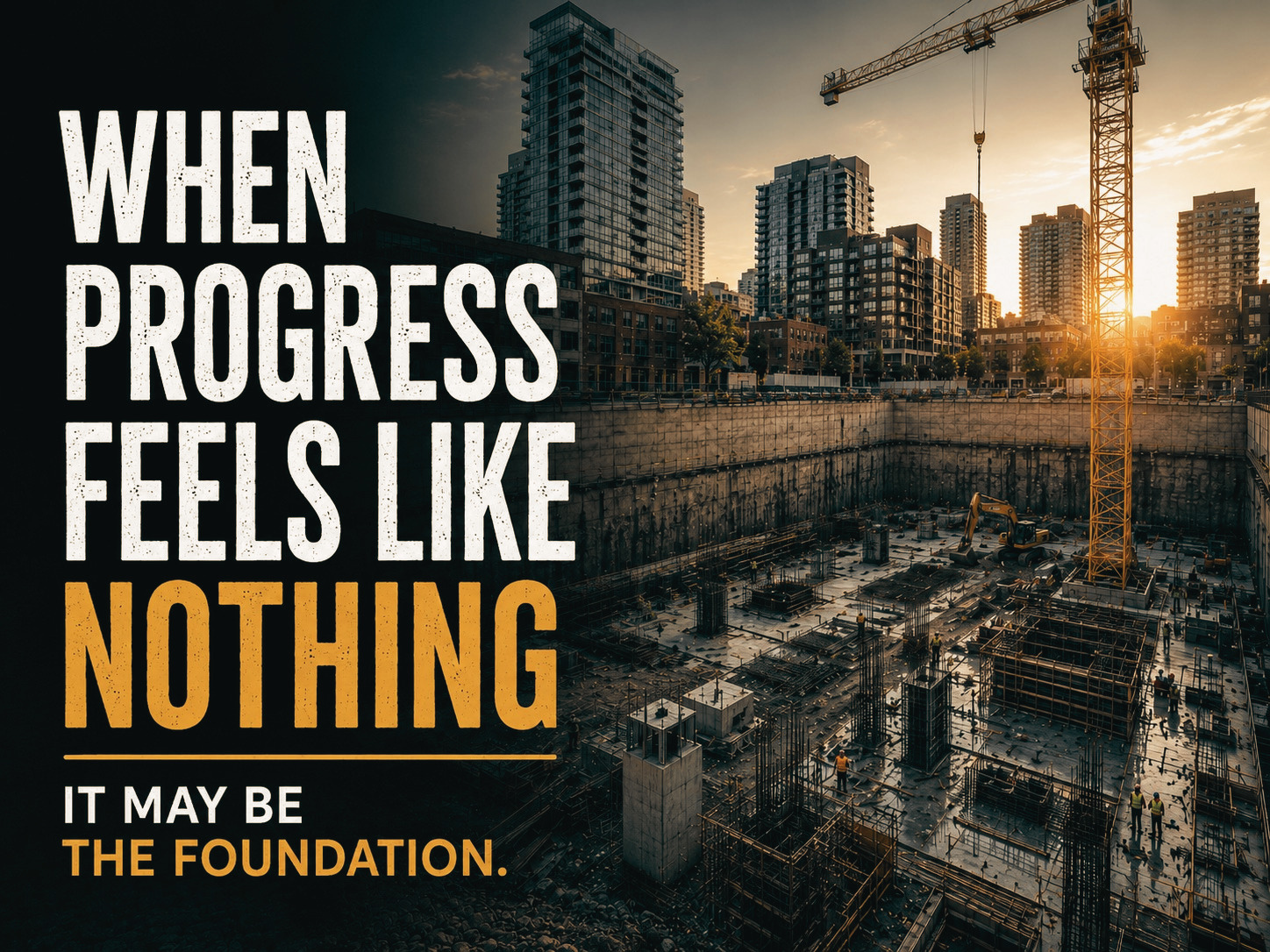
For several years, I lived near Yonge and Eglinton, an area that people jokingly called “Yonge and Construction.”
New condominium buildings were going up everywhere.
From my window, I would sometimes see an old house or apartment building being emptied. Then it would be demolished and completely removed.
After that, enormous machines would arrive and begin digging.
They would dig deeper and deeper until all that remained was a giant hole in the ground.
And then, sometimes for months, that was all anyone could see.
No impressive lobby.
No balconies.
No glass exterior.
No sign of the tall building shown in the architectural drawings.
Just machinery, dirt, concrete and an enormous hole where something used to stand.
If you did not know what was being built, it could appear as though something had been destroyed and nothing had taken its place.
But the hole was not evidence that the project had failed.
The hole was part of the project.
Slowly, steel, beams and concrete would begin to fill the space. The foundation was being designed and laid according to the weight and scale of what would eventually stand above it.
The larger and heavier the building, the more carefully its foundation had to be built to support it.
Most of that work was slow, complicated and almost entirely invisible from street level.
But once the foundation was complete, the building above it often seemed to rise remarkably quickly.
What had looked like an empty hole was actually the part upon which everything else depended.
Life can look like this too
When you are trying to create something meaningful, progress does not always look like forward movement.
Sometimes an old structure has to come down first.
That structure might be:
a career that no longer fits who you are
a business direction that is not working
a relationship or role around which you built your identity
a familiar way of thinking that once protected you but now holds you back
a plan for your life that no longer reflects the life you want
When the old structure disappears, you may not immediately see what will replace it.
You only see the space it left behind.
This is often the most emotionally difficult part of change. You know that something has ended, but you cannot yet see the shape of what is beginning.
From the outside—and sometimes even to you—it may look as though your life is moving backwards.
But not every season that looks empty is empty.
You may be rebuilding your confidence.
Learning a new skill.
Recovering from burnout.
Applying for jobs without knowing which opportunity will open.
Starting a business before the clients arrive.
Trying to trust yourself after a difficult decision.
Creating routines that do not yet feel natural.
None of this produces the immediate satisfaction of seeing the finished building. But it may still be essential foundation work.
Why uncertainty leads to overthinking
The mind prefers visible evidence.
When you can see clear results, it is easier to believe that your effort matters. When the results are delayed or uncertain, the mind often tries to fill that gap by thinking harder.
You replay decisions.
You examine every possible mistake.
You compare your progress with someone else’s finished result.
You repeatedly ask whether you chose the wrong direction.
You try to predict the future before taking your next step.
Psychologists often use the term rumination to describe repetitive negative thinking that circles around distress without necessarily leading to a useful solution. Rumination is associated with anxiety and depression and may intensify existing distress. mean that every difficult thought is unhealthy or that you should avoid honest reflection.
Reflection can help you understand what happened and decide what to do next.
Overthinking keeps returning you to the same questions without creating greater clarity.
A useful question to ask yourself is:
Am I still learning something from this thought, or am I trying to think my way into complete certainty?
Complete certainty is rarely available during a life transition.
The goal is not to know every floor of the building before taking another step. It is to become clear enough about the foundation you need to lay today.
Not every hole automatically becomes a foundation
The construction metaphor is not an instruction to continue indefinitely in every difficult situation.
A building site does not become productive simply because people keep digging.
There is a plan.
There are measurements.
The ground is assessed.
Progress is reviewed.
Problems are identified and corrected.
Sometimes the design has to change.
Your life requires the same honesty.
Persistence matters, but persistence without reflection can keep you investing in something that is no longer right for you.
Before telling yourself to “just keep going,” pause and ask:
1. What am I actually trying to build?
Move beyond a vague answer such as success, happiness or a better life.
What are you trying to create in your career, relationships, health, identity or daily experience?
The clearer the building, the easier it becomes to identify the foundation it requires.
2. What no longer supports that future?
Something may need to be released before something new can take shape.
That might be an unrealistic expectation, an old definition of success, a habit of comparing yourself with others, or the belief that changing direction means you have failed.
3. What foundation work am I doing?
Name the actions that may not yet be producing visible results.
Perhaps you are learning, healing, networking, writing, practising, applying, resting or rebuilding a routine.
Invisible progress becomes easier to trust when you can describe it accurately.
4. Am I acting—or only thinking about acting?
Overthinking can sometimes imitate preparation.
The mind stays active, but your life remains in the same place.
Ask yourself what one concrete action would move the situation forward, even slightly.
5. What would tell me that I need to adjust the plan?
Keeping going does not mean refusing to learn.
Decide what evidence would suggest that the strategy—not your worth—needs to change.
This helps you remain committed without becoming rigid.
A simple practice for an overthinking mind
When your thoughts begin turning a difficult day into a prediction about your whole future, try this short exercise.
Pause and take one slower breath.
Then complete these three sentences:
The story my mind is telling me is…
What I know to be true today is…
The next foundation-building action within my control is…
For example:
The story my mind is telling me is that because I have not found the right opportunity yet, I never will.
What I know to be true today is that the process is taking longer than I hoped, but I am still learning, applying and having conversations.
The next action within my control is to contact one person, improve one application or give myself the rest required to begin again tomorrow.
This is not about forcing yourself to think positively.
It is about separating facts from fearful forecasts and returning your attention to the part of life you can influence.
That is also the principle behind the Medit-Action Method™ at The Calm Mind: becoming calm enough to see the situation more clearly and then taking purposeful action from that clarity.
When support may help
You do not need a coach for every difficult day.
But support can be valuable when overthinking has become so constant that you can no longer tell the difference between a real problem, a possible problem and a fear created by exhaustion.
A focused coaching conversation may help when:
you feel stuck between several options
you are repeatedly second-guessing your decisions
a career or life transition has affected your confidence
fear of failure is preventing you from taking action
you are working hard but no longer know whether you are moving in the right direction
you need a calm, objective space to understand what this season is asking of you
Life coaching does not replace therapy, diagnosis or medical treatment. It can, however, provide a structured space for reflection, self-awareness, practical planning and forward movement.
At The Calm Mind, I work with professionals and individuals navigating stress, overthinking, burnout, uncertainty and important life transitions.
The objective is not to tell you to keep digging regardless of what is happening.
It is to help you understand what you are building, what foundation it requires and what your next honest step needs to be.
The part people rarely see
One day, people may look at the building and notice its height.
They will see the finished exterior, the lights in the windows and the life taking place inside it.
Very few will think about the months when all that could be seen was a hole in the ground.
Life is often similar.
People see the new opportunity, the stronger confidence, the successful business, the healthier relationship or the person you eventually become.
They do not always see the uncertainty that came before it.
They do not see the applications that went unanswered, the plans that changed, the quiet rebuilding or the mornings when you had to find the courage to try again.
So when all you can see is the hole, do not automatically conclude that nothing is happening.
Pause.
Look more carefully at the work taking place beneath the surface.
You may not be witnessing the absence of progress.
You may be laying the foundation for a life your old structure could not have supported.
Ready to find greater clarity?
When you are inside a difficult season, it can be hard to see whether you need to persist, pause or change direction.
You can book a complimentary 30-minute clarity conversation with Ashish Singh, award-winning life coach, author and founder of The Calm Mind.
It is a private, pressure-free conversation to explore what you are navigating, understand the patterns keeping you stuck and identify a clearer next step.
Sessions are available online for people in Toronto, Mississauga, across the GTA, Canada and beyond.
Book your complimentary clarity conversation.
Frequently asked questions
Why do I feel stuck even though I am working hard?
Progress is not always immediately visible. Learning, rebuilding confidence, recovering from burnout, developing relationships and creating a new direction can take time before they produce an external result. It can help to identify the specific actions you are taking and determine whether they genuinely support the outcome you want.
How can I stop overthinking when life feels uncertain?
Start by separating facts from predictions. Notice what you know, what your mind is assuming and what action remains within your control. Mindfulness, reframing unhelpful thoughts and taking a small practical step can help interrupt repetitive mental loops. NHS guidance similarly recommends stepping back from unhelpful thoughts, examining the evidence and considering alternative perspectives. ing like I am going backwards mean I have failed?
Not necessarily. Transitions can involve releasing an old role, plan or identity before the new direction becomes visible. However, it is important to evaluate whether your current actions are creating a useful foundation or whether the plan needs to be adjusted.
Can life coaching help with overthinking and feeling stuck?
Life coaching can help you recognize thought patterns, clarify what matters, evaluate your options and turn reflection into purposeful action. Coaching is most appropriate when you want support with awareness, decisions, goals and forward movement rather than clinical diagnosis or treatment.
When should I choose therapy instead of coaching?
Consider speaking with a licensed mental health professional when your distress is severe, persistent, connected to trauma, significantly affecting daily functioning, or involves a mental health condition requiring clinical assessment or treatment. Coaching is not a replacement for therapy, psychiatric care or emergency support.
About Ashish Singh
Ashish Singh is an award-winning life coach in Toronto, founder of The Calm Mind and author of the Literary Titan Gold Award-winning book The Northern Light Within. He supports professionals and individuals experiencing overthinking, stress, burnout, uncertainty and life transitions through calm reflection, mindfulness-based tools and purposeful action.